


🇮🇳 CAA India 2024 Decision: Relief for Minorities from Pakistan, Bangladesh, and Afghanistan
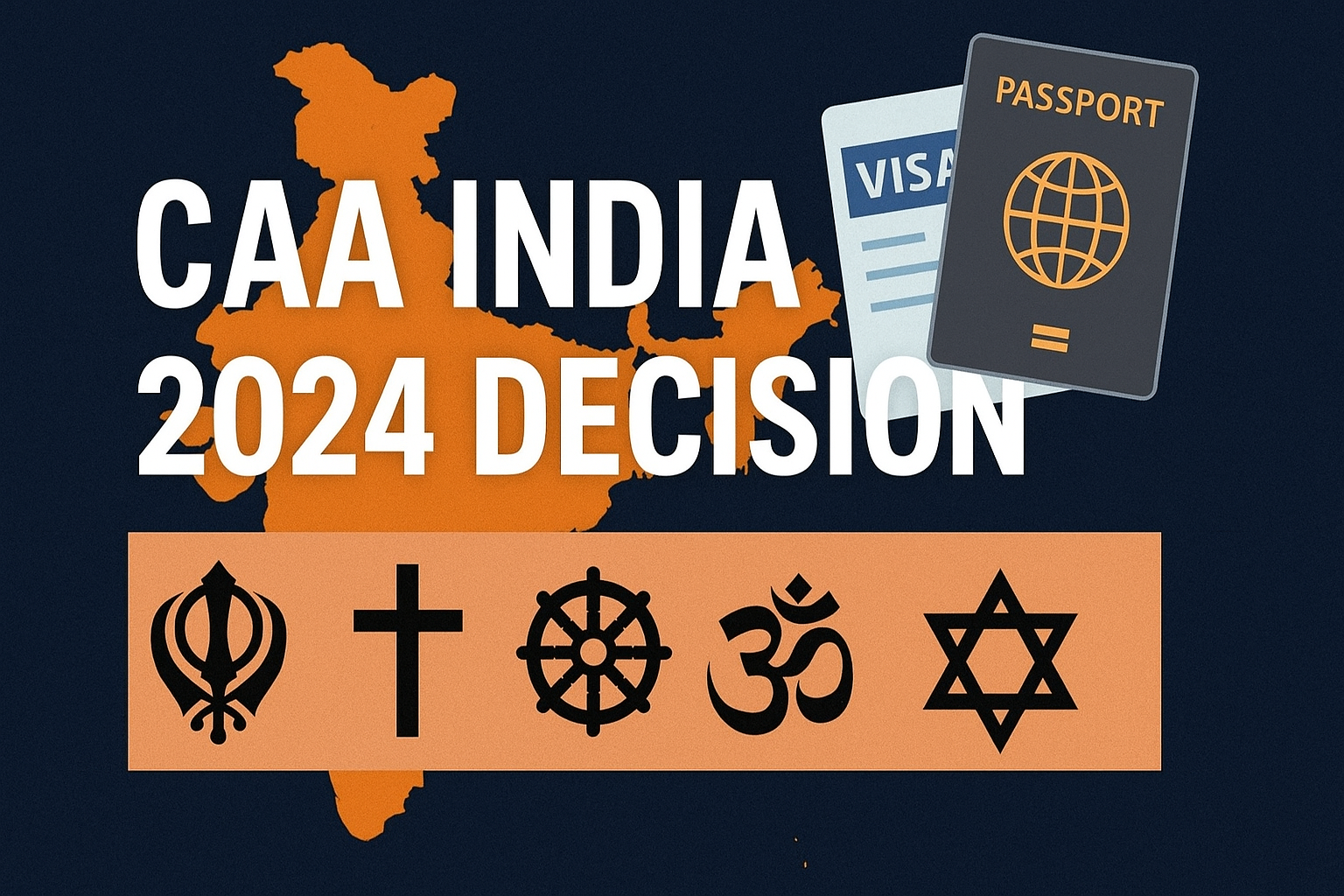
Table of Contents
A Historic Step by the Centre
The Government of India has taken a major decision under the Citizenship Amendment Act (CAA), providing relief to minorities from Pakistan, Bangladesh, and Afghanistan who entered India before 31 December 2024 due to religious persecution.
According to the order issued by the Ministry of Home Affairs (MHA), members of Hindu, Sikh, Buddhist, Jain, Parsi, and Christian communities will be exempted from the requirement of having a passport and valid visa to stay in India.
This CAA India 2024 decision is being seen as a significant relief measure for thousands of migrants, especially Hindus from Pakistan, who have long awaited clarity on their legal status in India.
What is the CAA? A Quick Background
The Citizenship Amendment Act (CAA), passed by the Indian Parliament in December 2019, aims to provide citizenship to persecuted religious minorities from Pakistan, Bangladesh, and Afghanistan.
Key highlights of CAA:
- Covers Hindus, Sikhs, Buddhists, Jains, Parsis, and Christians.
- Applies to those who entered India on or before 31 December 2014 (extended to 2024 under the new decision for stay).
- Excludes Muslims, sparking nationwide protests and debates.
- Provides a fast-track route to Indian citizenship.
The CAA India 2024 decision is an implementation step ensuring relief until the final citizenship process is completed.
The 2024 Decision Explained
Under the latest MHA order:
- Religious minorities from Pakistan, Bangladesh, and Afghanistan entering till 31 December 2024 are exempted from strict passport and visa requirements.
- These individuals will not be treated as illegal migrants under the Foreigners Act.
- They will be allowed to apply for citizenship once the rules are fully operational.
This decision has come as a ray of hope for thousands of migrants, many of whom have been living in refugee camps or settlements in states like Rajasthan, Gujarat, Delhi, Haryana, and Madhya Pradesh.
Who Will Benefit from the CAA India 2024 Decision?
The main beneficiaries include:
- Hindus from Pakistan – particularly from Sindh and Balochistan, who migrated to Rajasthan and Gujarat.
- Sikh families from Afghanistan – who fled persecution from Taliban forces.
- Christians and Parsis from Pakistan – who faced discrimination and threats.
- Buddhists from Bangladesh – primarily from the Chittagong Hill Tracts.
According to estimates, more than 31,000 migrants across India are waiting for CAA citizenship, and this new order offers them immediate legal relief.
State-Wise Impact of the CAA India 2024 Decision
- Rajasthan: Hosts the largest number of Pakistani Hindu migrants. Cities like Jodhpur and Barmer are home to refugee colonies.
- Gujarat: Thousands of migrants settled in Kutch and Ahmedabad.
- Delhi NCR: Refugee camps in Majnu ka Tilla and Rohini.
- Punjab & Haryana: Sikh families from Afghanistan.
- Madhya Pradesh & Maharashtra: Smaller settlements of persecuted communities.
For these migrants, the CAA India 2024 decision means they no longer have to fear deportation or legal harassment.
Political Reactions
- BJP & Centre: Called it a “historic and humanitarian step”, fulfilling their electoral promise.
- Opposition Parties: Criticized the exclusion of Muslims, calling it discriminatory.
- Human Rights Groups: Raised concerns over fairness and equal treatment under the law.
- Public Sentiment: Divided, with some welcoming the relief for persecuted minorities, while others worry about long-term demographic impacts.
The CAA India 2024 decision has reignited debates around secularism, constitutional equality, and humanitarian obligations.
Legal Angle: Passport and Visa Exemption
Normally, entry into India without a valid passport and visa makes an individual an illegal migrant under the Foreigners Act and Passport Act.
However, under the CAA India 2024 decision:
- These migrants will not be prosecuted for illegal entry.
- They will be considered for long-term visas and eventually citizenship.
- The exemption order provides them legal protection until the CAA process is completed.
This is a temporary but vital step to ease the uncertainty faced by migrants.
Impact on India-Pakistan-Bangladesh-Afghanistan Relations
- Pakistan: Strongly opposed CAA since 2019, claiming it targets its image globally.
- Bangladesh: Initially cautious, but later distanced itself from the debate.
- Afghanistan: Political instability has made minority safety a global concern.
- India: Faces diplomatic challenges but continues to defend the CAA as a “humanitarian law.”
The CAA India 2024 decision will likely strain relations further with Pakistan but strengthen India’s image as a safe haven for persecuted minorities.
Challenges Ahead
While the decision offers relief, challenges remain:
- Implementation Delays: Citizenship rules still not fully operationalized.
- Resource Strain: States need funds for housing, healthcare, and education of migrants.
- Identity Verification: Ensuring only genuine persecuted migrants get benefits.
- Public Resistance: Protests from groups opposing CAA could re-emerge.
Global Perspective: India’s Stand on Humanitarian Grounds
Internationally, India has defended CAA as a protection law for minorities, similar to how the U.S. and Europe grant asylum.
However, critics argue it goes against India’s secular Constitution by excluding Muslims.
The CAA India 2024 decision will again put India under the spotlight at global human rights forums.
Conclusion: A Milestone in the CAA Journey
The CAA India 2024 decision marks a turning point in India’s handling of persecuted minorities. By exempting them from strict passport and visa rules, the government has provided immediate relief and cleared the path for their eventual citizenship.
For thousands of families, this means hope, dignity, and stability after years of uncertainty. However, the debates around inclusivity, secularism, and fairness will continue to shape the larger narrative of CAA in the years ahead.
FAQs on CAA India 2024 Decision
Q1. What is the CAA India 2024 decision?
A: The government exempted minorities from Pakistan, Bangladesh, and Afghanistan entering till Dec 31, 2024, from passport/visa rules.
Q2. Who are eligible under this order?
A: Hindus, Sikhs, Buddhists, Jains, Parsis, and Christians.
Q3. Does this mean they get citizenship immediately?
A: Not immediately, but they are legally allowed to stay and later apply for citizenship.
Q4. How many people may benefit?
A: Around 31,000 migrants currently living in India are expected to benefit.
Q5. Why are Muslims excluded from CAA?
A: The government argues CAA is for religious minorities facing persecution in Islamic-majority nations.